You Only Ever See One Shelf
One carrier's plans, presented as the whole market. We're contracted across many carriers, including the major ACA plans and supplemental lines, so a quote from us is a comparison rather than a pitch.
I'm Willman, an independent employee benefits consultant licensed in five states. I'm contracted with many carriers, which means I can put the plan that fits your budget and your people in front of you, instead of the one plan I'm allowed to sell.
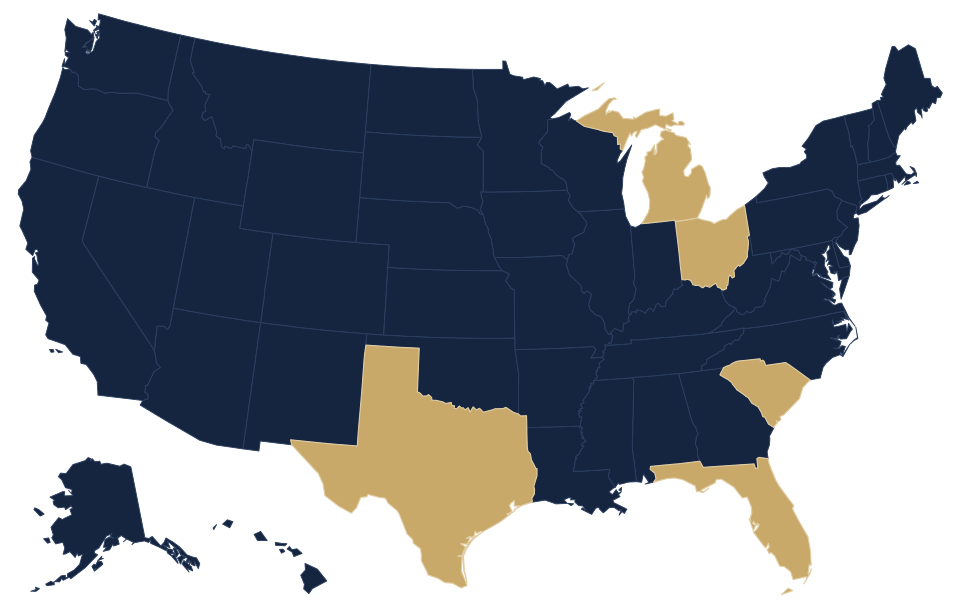
We write employer health coverage and employee benefits for small businesses based in any of the following states.
How many carriers is your agent actually contracted with? If the answer is one, that isn't a character flaw. It's their contract.
A captive agent can only sell you what their carrier sells. So the best option available that you were shown was really the best option they were allowed to show you. Anything better sitting one carrier over never made it into the room.
That is how a small business ends up paying more for less. And when the premium climbs, the employer contribution is usually what gets squeezed, until the employee's share gets high enough that people quietly opt out of their own coverage. That last part is the one that actually costs you: it is how good employees end up uninsured, and how they end up leaving for the company down the road that pays a little less but covers a lot more.
One carrier's plans, presented as the whole market. We're contracted across many carriers, including the major ACA plans and supplemental lines, so a quote from us is a comparison rather than a pitch.
Plenty of businesses hear from their agent twice: once at the sale, once at renewal. When a claim gets denied in March, nobody picks up. We stay reachable year-round, including after hours, because that's when people actually have time to ask.
An increase lands in your inbox and the only question you're asked is whether to sign. We benchmark your plan against comparable groups, re-shop the market, and go into the renewal ready to push back with something behind it.
Losing a good employee to a larger competitor's benefits package costs far more than the coverage would have. Often the fix isn't a bigger budget, it's a better structure: the same spend arranged so it buys more for the people it's meant to protect.
Premiums are only part of the cost. A Section 125 arrangement changes what you and your employees pay in payroll tax. Reporting and notice requirements shift as your headcount changes. We keep those in the conversation instead of leaving them for your accountant to discover later.
When I was eleven, I got hurt playing sports. Both of my parents had insurance available through their jobs, and both of them had opted out, because opting out meant a little more in every paycheck.
So the bill came to us instead. It was about two thousand dollars, and we couldn't pay it. By the time I turned eighteen, interest and collections had grown it past nineteen thousand. I was afraid to go to college, not because of tuition, but because of a hospital bill I got at eleven years old.
I started working in health insurance that same year. That's still the whole job to me: make sure the employer understands what they're actually buying, make sure the employee understands what they actually have, and make sure nobody learns how their plan works for the first time in an emergency room.
In trucking and construction, the people who make you money usually aren't W-2 — so most agents have nothing at all to offer them.
Your drivers and your subs can take dental, vision, accident, life and disability through the business, at the business's rate rather than the retail rate they would pay on their own. They enroll, they pay, and the business contributes nothing. It is the difference between answering "nothing" when a good man asks what you offer, and answering with something.
Bring your current plan to a 30-minute call. We'll walk through what it covers, what it leaves your employees exposed to, and whether there's a better structure for the same money. If there isn't, we'll tell you that.
